Positively Naperville | Birth of Scuba Therapy
I had no burning desire to learn how to scuba dive, but as a young journalism student at the College of DuPage in Glen Ellyn, Illinois, I thought that as a reporter I might have to know how to scuba dive in the event I ever had to do a story on a famous scuba diver like Jacques Cousteau. So I took a scuba class.
After finishing the academic and pool work at COD, I ventured to Key Largo, Florida, to complete the open water portion of the training. Once I found myself 20 feet underwater and 20 feet above the coral reef, I realized that I was flying, hovering weightless in the water column.
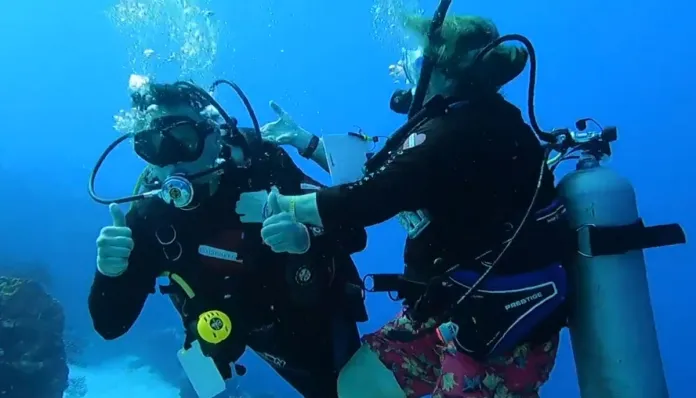
Glancing up and down in midwater made me feel like a superhero or astronaut. It was for me. I immediately realized that scuba diving was in some way therapeutic. As I began teaching scuba diving to people with disabilities in 1997, I simultaneously reached out to the head of physical therapy at Midwestern University in Downers Grove, explaining the physical and psychological benefits that I was seeing in my students.
Over the next 25 years, Diveheart and Midwestern would partner on several research projects, including the first study in the world on autism and scuba therapy. In the early years, we also gave birth to the first scuba therapy class which I conducted at the warm water therapy pool at Good Samaritan Hospital’s new Recreation Center in Downers Grove. The scuba therapy class was not about getting a student certified but rather give them an in water zero gravity experience.
I taught students how to use their breath to control their body position in the water. I would even have them close their eyes while balancing in shallow water and listen to their breathing while they focus on their up and down movement in the water column. It was so relaxing for the students that many came back for multiple scuba therapy sessions.
I believe that scuba diving provides benefits to one’s body, mind and spirit.
Over the years this realization has caught on in the scuba and medical community. In fact, four years ago Diveheart was approached by Mayo Clinic and now presents on scuba therapy every year at Mayo’s annual medical conference.
Diveheart continues to grow, inspire and facilitate scuba therapy by presenting at grand rounds to physicians and researchers at Duke, Northwestern and other university medical centers around the world.